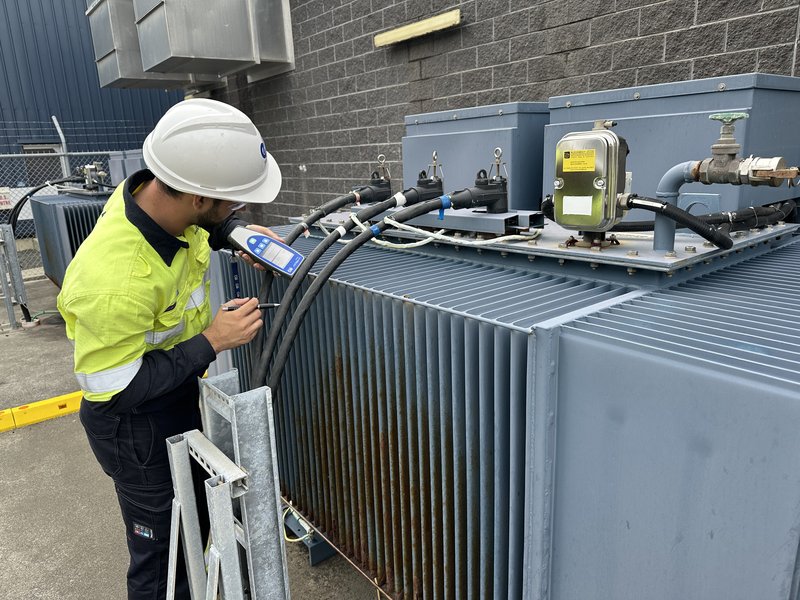
Partial Discharge Monitoring: Extending asset life without the guesswork
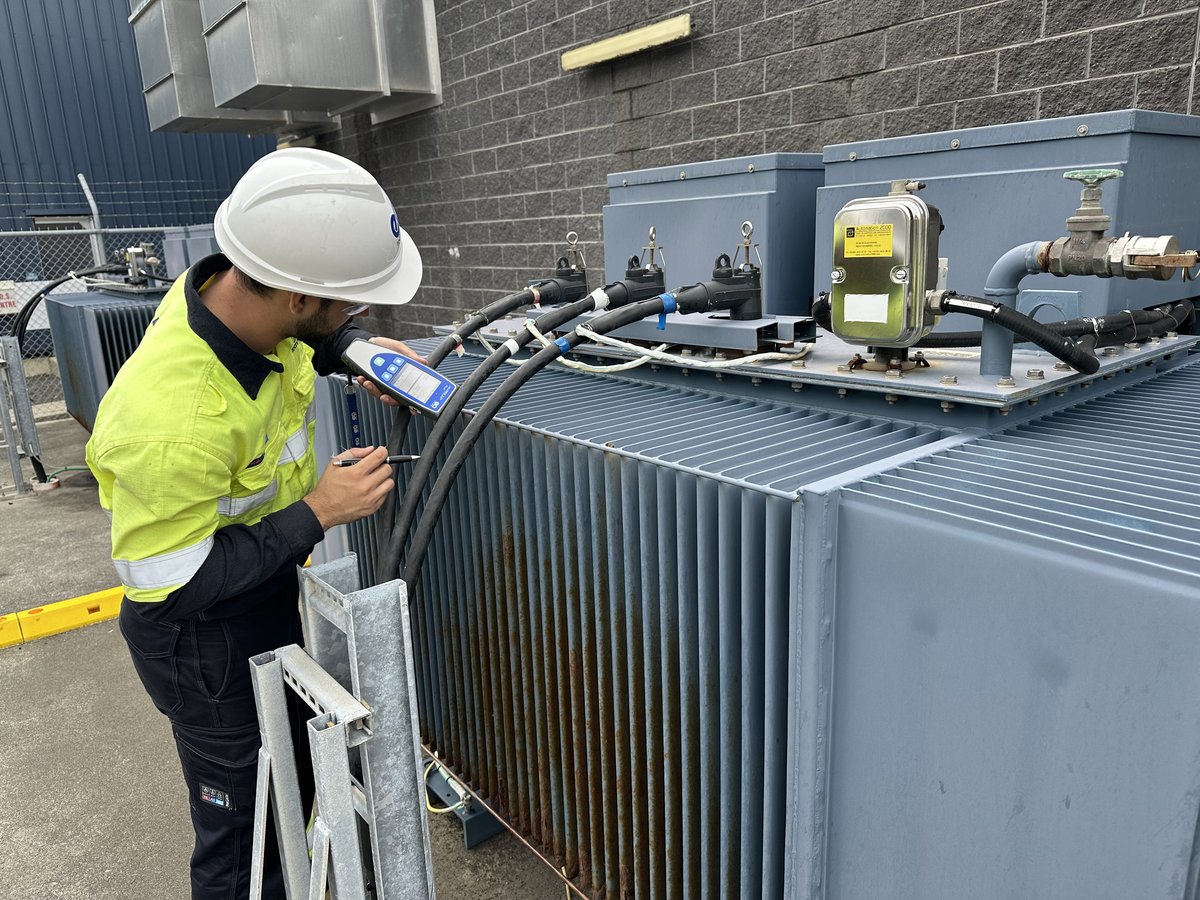

Across Australia, coal-fired power stations are running years beyond their planned retirement, and their switchgear, transformers and HV cables must keep running with them. Online partial discharge (PD) monitoring gives asset managers the condition data they need to decide whether to run, refurbish or replace these assets, without taking them out of service.
Key takeaways
An estimated 80–85% of disruptive switchgear failures stem from insulation degradation, and partial discharge is its earliest detectable sign.
Online PD techniques (TEV, ultrasonic, HFCT and UHF) assess energised assets with no outage.
Periodic handheld surveys build a site baseline; continuous monitoring tracks whether a defect is stable or escalating.
New assets should be designed for monitoring at commissioning, with access points, external earth screens and pre-installed sensors.
Why ageing grid assets need better condition data
Australia's grid is being held together by baseload assets that were meant to be retired. The country's largest coal-fired power station, Eraring in New South Wales that has been operating for more than 40 years, will now run until 2029. Similarly, the Vales Point coal-fired power station will be more than 50 years old if it shuts down in 2033.
When a station's life is extended, so is the life of everything connected to it. Switchyards, generator transformers and connection cables are now expected to perform well past their intended service life.
That raises a hard question: do asset managers know the condition of assets they never expected to keep running? For most, the honest answer is "not well enough". Many of these assets were never designed to be monitored, so the priority is to gain visibility without taking them out of service.
Leading vs lagging indicators in asset management
Lagging indicators such as asset failures or past non-conformities only reveal problems after they've occurred. Leading indicators provide early warning by tracking the condition of an asset, enabling predictive maintenance before failures happen.
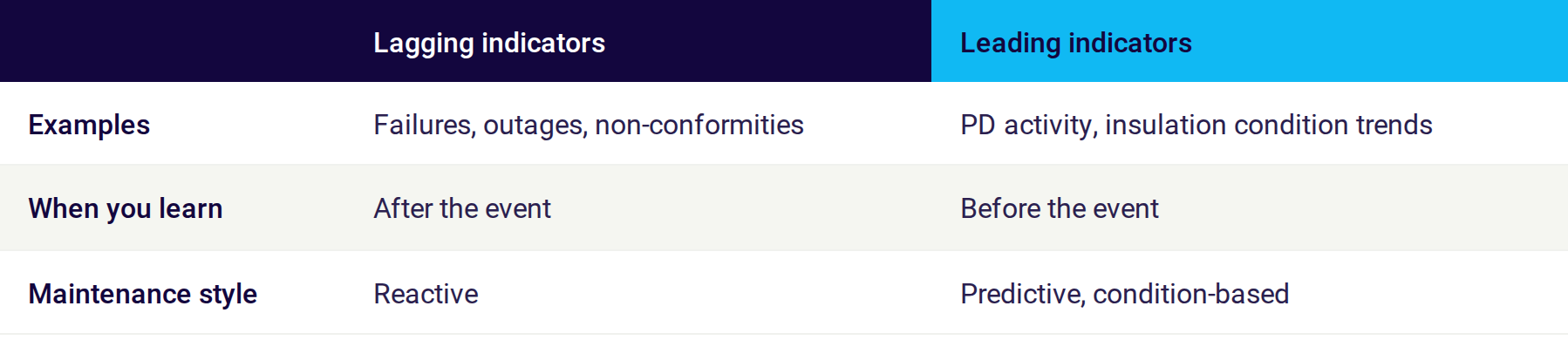
By moving to a leading indicator framework, we might get greater visibility of asset conditions. It would be ideal to have this visibility planned during the acquire stage of its lifecycle when engineers consider how condition data will be collected over the asset's life. But most assets that operate today were not designed to be monitored, and the priority would be to gain visibility of these assets without taking them out of service.
Insulation degradation: the main cause of switchgear and cable failures
Insulation degradation is one of the primary causes of failure in switchgear. EA Technology estimates that 80 to 85 per cent of disruptive switchgear failures stem from insulation issues. Partial Discharge (PD) is an early indicator of that degradation, making it the most critical condition to detect and trend.
High-voltage (HV) cables face the same risk, yet they are among the most difficult assets to monitor once installed. In cables, PD is most often linked to workmanship issues in joints and terminations and is the dominant cause of unexpected failures. This means, the condition data is hardest to obtain exactly where the cost of failure is highest.
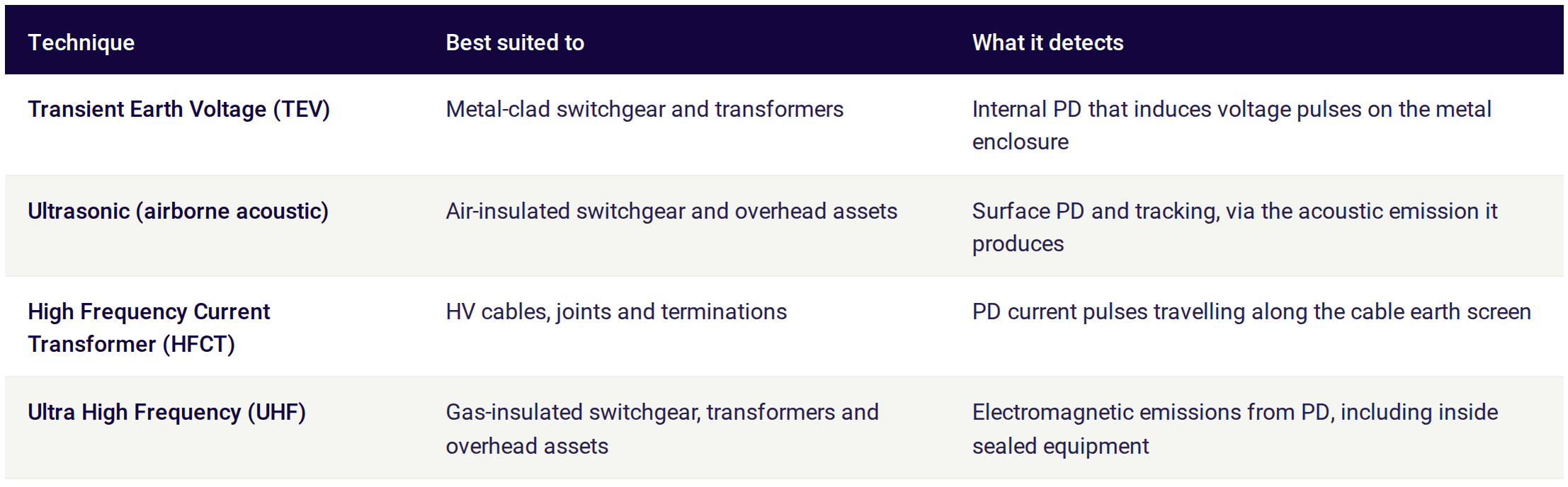
Online partial discharge detection methods (TEV, ultrasonic, HFCT, UHF)
Online PD detection lets engineers assess assets while they remain energised, with no outage. Different assets need different techniques, and combining them gives a more complete picture than any single measurement.
From handheld PD surveys to continuous monitoring
Periodic handheld surveys have also proven to be a practical starting point. This builds a condition baseline across a site and identifies assets that need closer attention.
Where a survey finds PD activity on a critical asset, continuous monitoring takes over. It delivers data trends over time, showing whether a defect is stable or has started to escalate.
Survey: Run handheld PD surveys across the site to establish a baseline.
Prioritise: Flag critical assets showing PD activity.
Monitor: Install continuous monitoring on flagged assets to trend PD over time.
Decide: Use the trend to run, refurbish, replace or prioritise maintenance.
For an asset with an extended operating lifespan, this data informs whether asset owners should run, refurbish, replace or maintain it as a priority.
Designing new assets for condition monitoring at commissioning
Some monitoring constraints can only be solved at the design and commissioning stages. Once an asset is in service, the options narrow sharply.
Long HV cable circuits. A newly commissioned HV cable circuit longer than 16 km may be installed without intermediate switching points or accessible test locations. Current testing methods cannot cover its full length, so large sections stay invisible until a failure occurs. Designing with monitoring in mind, by adding section points or access locations, makes inspection viable.
Sealed earth screen terminations. Where earth screens terminate inside sealed enclosures, HFCTs cannot be fitted without a shutdown once the system is live. Installing HFCTs at commissioning, or bringing earth screens out externally for safe access, allows cables to be monitored online from day one.
Making decisions from evidence
The lifespan of an asset is increasingly being shaped by forces beyond its design brief. Few asset owners planned for their assets to run well past their intended retirement. Condition data would make that extension far easier to manage, but many of these assets were never designed to provide it. The assets being extended today show what happens when condition data is an afterthought, and the assets being built today will face the same uncertainty.
For existing assets, online PD surveys provide the visibility that was never designed to run without an outage. For new assets, embedding access points, externalising earth screens and installing sensors at commissioning will allow condition data to be gathered for as long as the asset is needed.
By shifting from lagging to leading indicators, asset owners can reduce risks, extend the lifespan of an asset and make ongoing decisions with greater evidence.
Talk to us about your ageing assets
If your switchgear, transformers or HV cables are running past their planned retirement, a PD survey is the fastest way to find out where you stand. Get in touch with us to arrange one.
Frequently asked questions
What is partial discharge? Partial discharge is a localised electrical breakdown in a small part of an insulation system that does not fully bridge the conductors. It is an early sign of insulation degradation and, left unchecked, can lead to complete failure.
Can partial discharge be detected without an outage? Yes. Online techniques such as TEV, ultrasonic, HFCT and UHF measure PD while equipment stays energised, so assets can be assessed in service.
How often should switchgear be surveyed for partial discharge? It depends on asset criticality, age and previous results. Many owners survey annually to build a baseline, then move critical assets showing PD activity to continuous monitoring.
Why is PD testing difficult on long HV cable circuits? Circuits longer than about 16 km often lack intermediate switching points or test access, and current methods cannot cover the full length. Without access designed in, large sections cannot be inspected.
What is the difference between leading and lagging indicators? Lagging indicators, like failures, show problems after they happen. Leading indicators, like PD trends, give early warning so maintenance can be planned before failure.